





After Mathieu van der Poel (Alpecin Premier Tech) won solo in his first Omloop Nieuwsblad (see here for a video summary of the 2026 Omloop Nieuwsblad), the opening weekend in Belgium continues tomorrow with Kuurne-Brussels-Kuurne 2026. CONTINUE READING AFTER THIS ADVERTISEMENT
The classics season is in full swing, and this is only the beginning, as we continue this week with the Ename Samyn Classic in Belgium (Tuesday) and Strade Bianche in Italy (Saturday).
In this post, you will find the route of Kuurne-Brussels-Kuurne 2026 on an OpenStreetMap map and in Google Earth, as well as the race schedule and profile, and the list of starters.
You can also find this route in the Maps section of the velowire app, for easier access and to enjoy seeing your own location on the map!
The Kuurne-Brussels-Kuurne 2026 route on an OpenStreetMap map, the race profile and the timetable
The route for Kuurne-Brussels-Kuurne 2026 is similar to that of 2025, but there are still several differences. So let's not wait any longer and take a closer look at this route!
First of all, for clarity, the route has been divided into two parts on the map below: the outward journey is shown in blue with a thick line and the return journey is shown in red with a line of normal width. In addition, arrows around the route indicate the direction at points where there may be some doubt, always following the principle that at a given point, the black arrow is followed by the riders before the red arrow.
After leaving Kortrijk, the race quickly passes the finish line in Kuurne, in the opposite direction to the final finish, then the actual start after 7 km of parade route before heading towards the first climb of the day, the Tiegemberg (1400 m / 4%).
After passing through Kluisbergen and then Audenaarde (Oudenaarde), the riders then encounter five climbs in quick succession: the cobbled Volkegemberg (1000 m / 5.1%), then — after the feed zone and a short loop through Brakel — the Lepelstraat climb (2100 m / 3.4%) and then, having started the red section of the course, Bossenaarstraat (1300 m / 5.6%), another feed zone, Berg Ten Houte (1100 m / 6.2%) and La Houppe (1880 m / 4.8%).
Passing through Vloesberg, they then descend southwards before turning west towards a series of three other hills: Hameau des Papins (1200 m / 6.6%), Le Bourliquet (1300 m / 6.8%) and Mont Saint-Laurent (1300 m / 7.8%) on cobblestones, followed by a feed zone.
They then pass through Ronse before reaching a series of four final climbs: Kruisberg (1,400 m / 5.3%) on cobblestones, Hotond (1,200 m / 3.1%), Côte du Trieu (1260 m / 7%) and Kluisberg (1100 m / 6%), which will be the thirteenth and final climb.
After that, the course becomes easier and flatter, and the short cobbled section of Beerbosstraat (500 m) will not really bother the riders either. Passing close to the start in Kortrijk, they arrive at the final circuit where they cross the finish line, this time in the right direction, before completing an additional loop and crossing the finish line in Kuurne to compete for victory in this 78th edition of Kuurne-Brussels-Kuurne! So, by the end of the afternoon on Sunday, we will know the name of the successor to Jasper Philipsen (Alpecin Premier Tech).
Below you will find the route schedule, profile, and OpenStreetMap map for Kuurne-Brussels-Kuurne 2026. Click on the images to enlarge them.
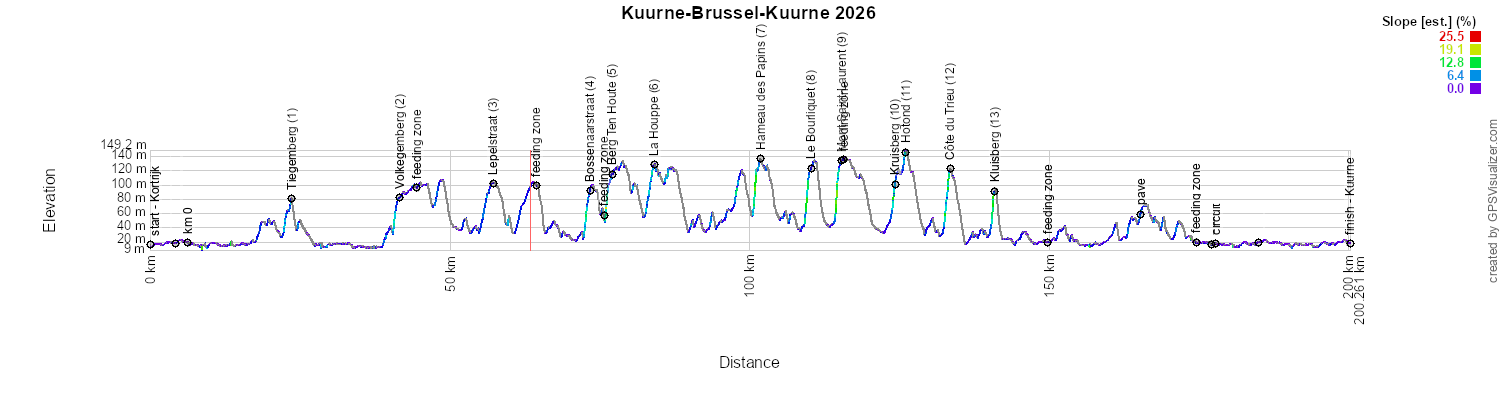

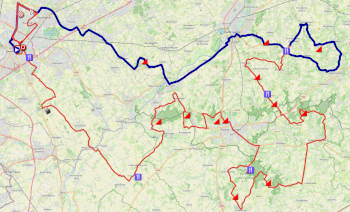
The route of Kuurne-Brussels-Kuurne 2026 in Google Earth
Would you prefer to view the route of Kuurne-Brussels-Kuurne 2026 in Google Earth, so you can take a virtual flight over this Belgian classic? You can do so by downloading the KML file below:>> Download the route of Kuurne-Brussels-Kuurne 2026 in Google Earth
CONTINUE READING AFTER THIS ADVERTISEMENT
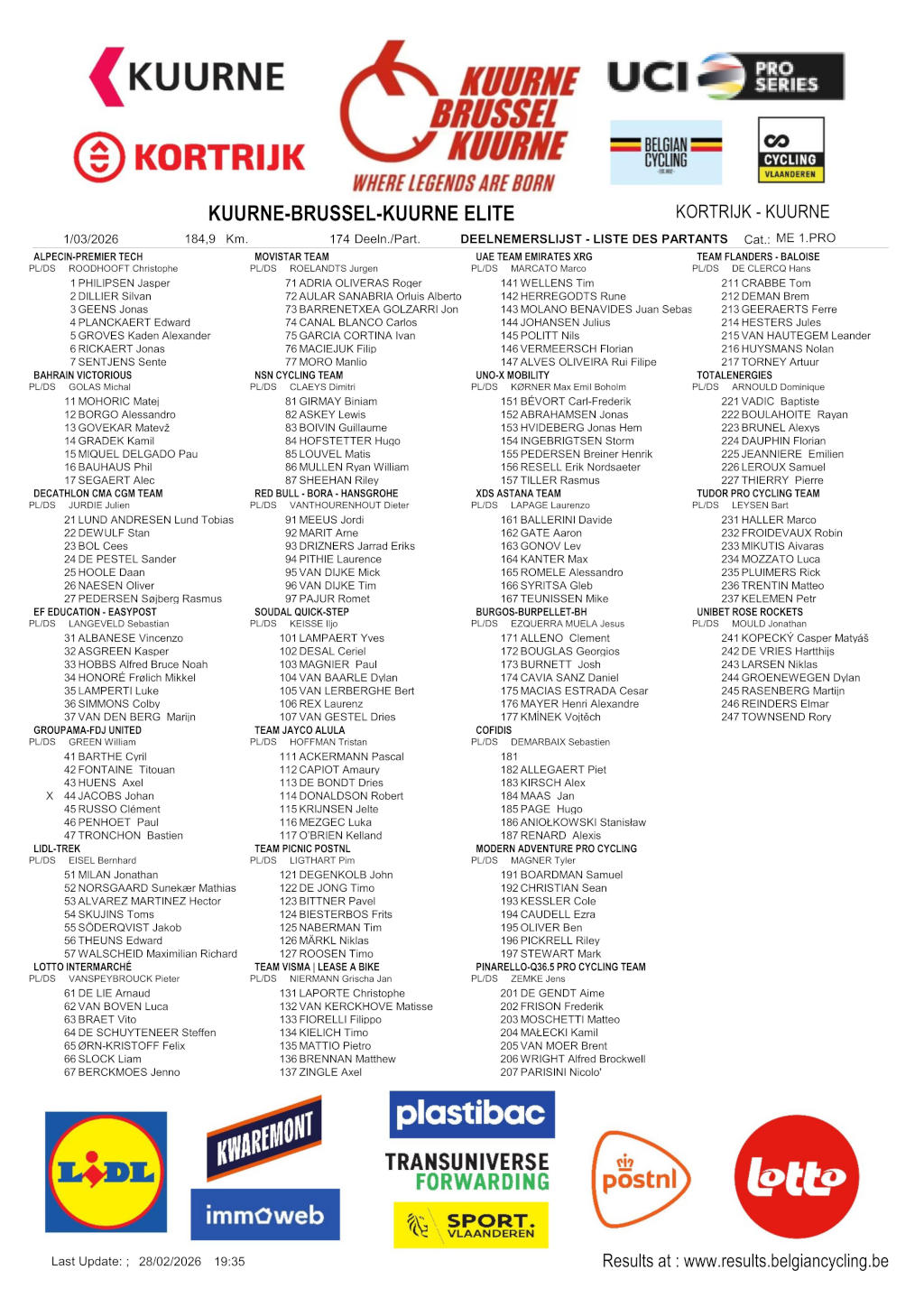
The list of starters for Kuurne-Brussels-Kuurne 2026
174 riders representing 25 teams of 7 riders each will start Kuurne-Brussels-Kuurne 2026 tomorrow.Below you will find the list of starters for Kuurne-Brussels-Kuurne 2026:
Vond u dit artikel interessant? Laat het uw vrienden op Facebook weten door op de buttons hieronder te klikken!
no comments yet | 3503 views
this publication is published in: Classics | OpenStreetMap/Google Maps/Google Earth
 by Yoshi45 over