





This Sunday, April 26, 2026, will mark the 112th edition of Liège-Bastogne-Liège, also known as La Doyenne. Despite the number of editions, are you still wondering why it has this nickname? When you consider that the very first edition took place in 1892 —more than 130 years before Liège-Bastogne-Liège 2026— you’ll no doubt understand why we refer to this Monument in this way!
Twelve years ago, on the occasion of the race’s 100th edition, I published the history of Liège-Bastogne-Liège—feel free to read it again!
As is the case every year, the Liège-Bastogne-Liège route changes slightly, though the famous climbs of La Redoute, Les Forges, and La Roche-aux-Faucons always feature in the final stretch.
Once again this year, the route changes slightly for Liège-Bastogne-Liège 2026, but this time at the start of the race, even before the first climb, with a detour from Aywaille to Logne before returning to Werbomont. The second change is the removal of the detour to include the Côte de Mont-le-Soie, which will therefore no longer be part of the 2026 Liège-Bastogne-Liège route; however, a little further on, the Col du Maquisard will make its return.
In this article, you’ll discover these changes, all the details of the 2026 Liège-Bastogne-Liège route with the route map on OpenStreetMap, which is also downloadable in Google Earth, the race profile, and the schedule. Plus, the list of starters!
CONTINUE READING AFTER THIS ADVERTISEMENT
The 2026 Liège-Bastogne-Liège map is even better in the app!
Below you’ll find the race map, of course, but if you really want to dive into this map… it’s even better in the velowire app! And as usual, it was available there before being published here! (starting Saturday evening)Whether you’re heading to the race—whether for one of the participating teams, the organization, one of its partners, or simply as a cycling enthusiast lining the route—or if you just want to explore the 2026 Liège-Bastogne-Liège map in a different way, velowire invites you to discover it in the Maps section of the velowire app for a more convenient experience. That way, you’ll always have it with you, and as a little bonus: you can view it in full-screen mode, and if you’re traveling to the event, display your location on the map and move the map along with you, making it easier than ever to get there!
So don’t wait any longer and join the hundreds of users of the app by downloading the velowire app from the app stores:
 |
| 
The 2026 Liège-Bastogne-Liège route on an OpenStreetMap
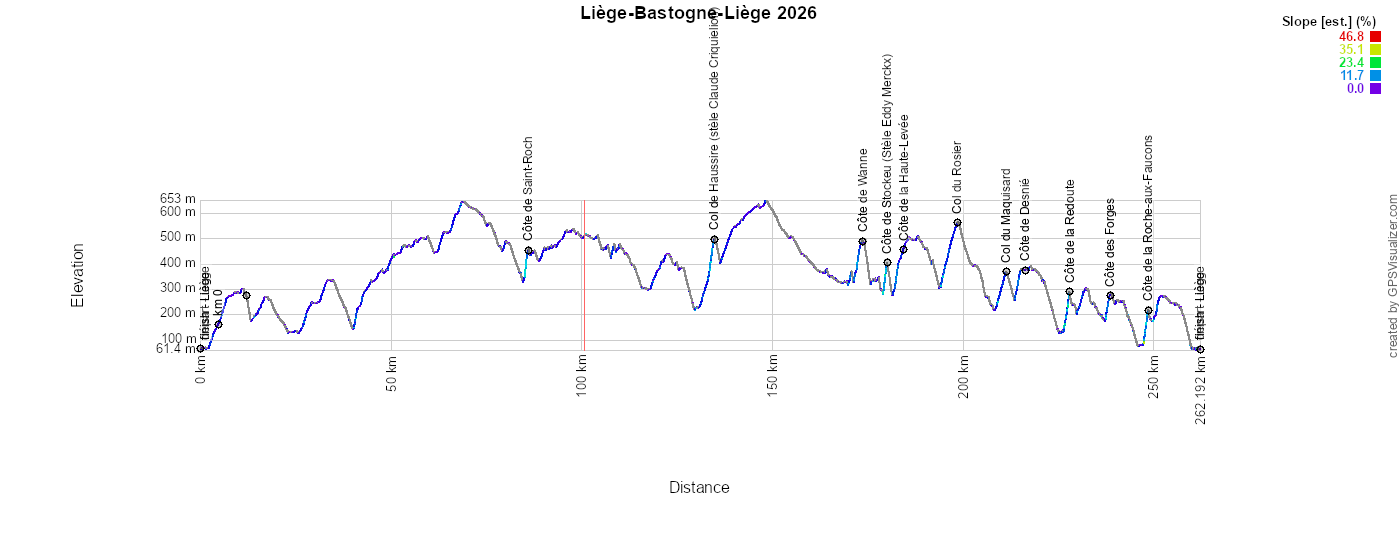
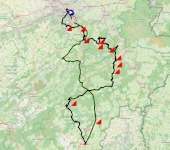
After the start from the Quai des Ardennes in Liège (which will also be the finish line) at 9:55 a.m. (the promotional caravan will depart at 8:30 a.m.!), the actual start will take place on the N30, 2.5 km from the gathering point, around 10:00 a.m. The race begins on the green section of the map (this is clearly not the “first half” of the race, because even though this section is longer this year than in previous years, the route from Liège to Bastogne is only about 97 km out of the total 259.5 km!).Via Sougné-Rémouchamps and Aywaille (where there is the small additional detour described above), the race then heads south toward Baraque de Fraiture, where the route crosses the return route (shown in black). The descent then continues toward Bastogne, via Houffalize and the Côte de Saint-Roch (1 km at 11.2%).
Upon arriving in Bastogne, the riders turn clockwise to begin the return route. After passing through Bastogne at the La Doyenne roundabout (this roundabout is dedicated to La Doyenne year-round), they head toward La Roche-en-Ardenne and the Col de Haussire (3.9 km at 6.8%). They then cut across the outbound route near Baraque de Fraiture to head toward the series of climbs, which this time does not begin with the Côte de Mont-le-Soie but with the famous trio that, over the course of about ten kilometers, includes the Côte de Wanne (3.6 km at 5.1%), Côte de Stockeu (1 km at 12.5%), where they pass the Eddy Merckx Memorial (five-time winner of the race, including three consecutive victories in 1971, 1972, and 1973), and the Côte de la Haute-Levée (2.2 km at 7.5%).
About fifteen kilometers further on, they reach the familiar Col du Rosier (4.4 km at 5.9%), followed by the return to the Col du Maquisard after five editions (2.4 km at 5.7%), quickly followed by the Côte de Desnié (1.6 km at 8.1%) and then the famous Côte de la Redoute, 34 km from the finish (2 km at 8.9%), the Côte des Forges (1.3 km at 7.8%) and the Côte de la Roche-aux-Faucons (1.3 km at 11%), whose summit is 13.4 km from the finish. The finish line is located on the Quai des Ardennes in Liège, just like the start.
The finish is scheduled between 4:02 p.m. and 4:39 p.m.
Below you will find the schedule, the route on an OpenStreetMap map, and the profile for Liège-Bastogne-Liège 2026. Click on the images to open them.

The 2026 Liège-Bastogne-Liège route in Google Earth
If you prefer to view the 2026 Liège-Bastogne-Liège route in Google Earth, for example to take a virtual tour, I invite you to download the race route in Google Earth by clicking on the following link:>> Download the 2026 Liège-Bastogne-Liège route in Google Earth (KML file)
The 2026 Liège-Bastogne-Liège start list and riders bib numbers
The 2026 Liège-Bastogne-Liège start list reveals that defending champion Tadej Pogačar (UAE Team Emirates XRG; winner in 2021, 2024, and 2025) will be competing, facing off against riders such as two-time winner (2022/2023) Remco Evenepoel (Red Bull-BORA-hansgrohe) and the recent (and youngest) winner of the Flèche Wallonne, Paul Seixas (Decathlon CMA CGM Team). Also in the mix are outsiders Tom Pidcock (Pinarello-Q36.5 Pro Cycling Team), Giulio Ciccone (Lidl-Trek), and Mauro Schmid (Team Jayco AlUla), as well as Mattias Skjelmose (Lidl-Trek), to name just a few.>> Official start list for Liège-Bastogne-Liège 2026
CONTINUE READING AFTER THIS ADVERTISEMENT
The 2026 Liège-Bastogne-Liège standings
Later this Sunday, you can find the results in the Liège-Bastogne-Liège 2026 profile on the UCI cycling calendar.door Thomas VergouwenVond u dit artikel interessant? Laat het uw vrienden op Facebook weten door op de buttons hieronder te klikken!
no comments yet | 13485 views
this publication is published in: Classics | OpenStreetMap/Google Maps/Google Earth
 by Yoshi45 over